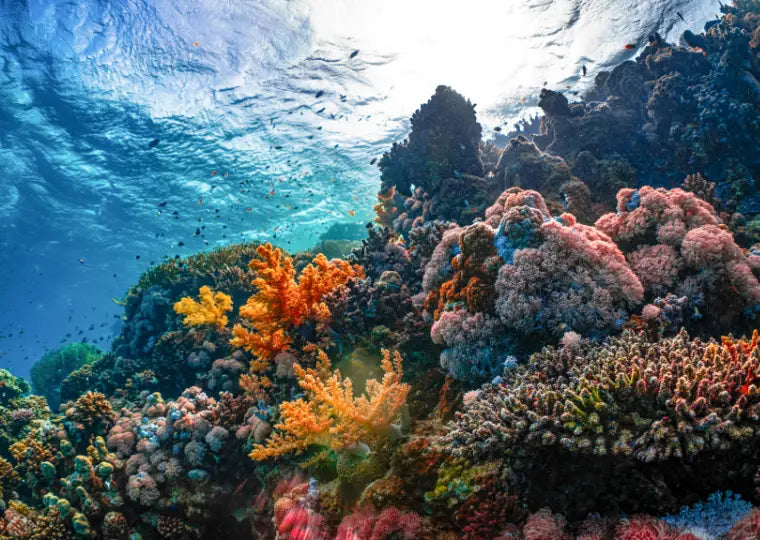
Reefs rise from the seabed like living cities, towers of coral, soft gardens of anemones. Fish schools flicker through the blue, like iridescent ribbons, as reef sharks trace the edges. Every ledge, crack and coral branch is home to something. A hiding place. A nursery. A hunting ground. A meeting place.
Bright, strange, busy, beautiful. A living architecture built by tiny animals over hundreds, sometimes thousands, of years. They are some of the most biodiverse and concentrated ecosystems on Earth - home to a quarter of all marine life while taking up less than 0.1% of the ocean floor.
Home to a quarter of all marine life
They are home to parrotfish, turtles, sharks, rays, clownfish, sea cucumbers, crabs, corals, algae, sponges and thousands of species still quietly doing their work beneath the surface. Coral reefs feed people, protect coastlines, support livelihoods and give the ocean some of its most electric, impossible beauty.
But their real power is not just in how they look. It is in what they hold together. Reefs are about relationships. Coral and algae. Predator and prey. Mangrove, seagrass and reef. Coastline and community. Life above the water, tied to life below it.
Reef biodiversity matters because every species plays a role. Herbivores keep algae from smothering corals. Predators keep fish populations in balance. Cleaner fish and shrimp remove parasites. Sea cucumbers and crabs clean the reef floor. Even sponges recycle nutrients that feed other reef species. A reef is not one thing. It is a whole orchestra, held together by a symphony of relationships.
That world is under pressure.
Rising ocean temperatures are driving coral bleaching and killing these fragile ecosystems. Pollution, overfishing, coastal development and shipping are destroying reefs and with it the home of a quarter of all marine life. WWF reports that the world has lost half of its coral reefs over the last three decades, and that more than 80% of the world’s reefs are now affected by bleaching.
Then there is plastic.
Plastic pollution does not just drift past reefs - it catches, scrapes, smothers and stresses them. A global Oxford University led study found human-derived debris on 77 out of 84 reefs surveyed, including some of the world’s most remote coral reef systems. Of that debris, 88% was macroplastic larger than five centimetres. There are now 500X more microplastic particles in the ocean than stars in the Milky Way.
This matters because coral is alive. When plastic comes into contact with coral, it can cause damage, block light, create low-oxygen conditions and increase the risk of disease. One widely cited study found coral disease likelihood rose from 4% to 89% when corals were in contact with plastic. (PubMed)
Losing reefs doesn't just mean losing colour. It would mean losing shelter, food, protection, income, culture, and one of the ocean’s great engines of life.
Reefs are in deep trouble.
But they are not gone. And that distinction matters.
As, Sir David Attenborough said: “Ocean recovery is possible within a single human lifetime - but only if we act now, with courage and leadership.”
Across the world, people are leading the patient, unglamorous, but essential work of restoration. One of those organisations is SeaTrees, an Ocean Bottle impact partner, whose projects help restore and protect coastal ecosystems, including coral reefs, kelp forests, mangroves, and seagrass meadows.
In Fiji, SeaTrees is working along the Coral Coast of Viti Levu. The project focuses on coral propagation, out-planting and community-based reef management, with heat-tolerant coral fragments grown in rope nurseries before being planted back onto the reef. It also supports no-take marine protected areas, sustainable fishing practices and long-term monitoring.
That is the kind of impact we believe in. Not quick fixes. Just real work, rooted in local communities, science and collective action.
At Ocean Bottle, we exist to protect the ocean and the ecosystems that make it thrive. Reefs are part of that story. Our impact model is simple: for every Ocean Bottle sold, we fund the collection of the equivalent of 1,000 plastic bottles before they reach the ocean. That is 25lbs of plastic stopped before it can enter the ocean.
Because protecting reefs is not just about what happens on the reef. It is about what flows into the ocean. It is about reducing plastic before it reaches coastlines. It is about supporting communities who collect it. It is about backing partners doing the hard, hopeful work of ocean restoration.
World Reef Day is a reminder to look below the surface. To see reefs not as distant, tropical postcards, but as living systems we are connected to. They help feed communities. They protect coastlines. They shelter a quarter of marine life.
And they need us to act like they matter.
So buy the bottle. Use it every day. Gift it to someone who gives a damn. Help fund plastic collection and ocean restoration. Help support a healthier ocean. Help keep these underwater cities alive. Because small, intentional choices add up. And beneath the surface, that can mean everything.